Bedside Voice-Activated Recorders for Immediate Lucid Dream Logs
Compare compact voice-activated recorders for immediate bedside dream notes by capture controls, storage, playback, transfer, and power routines.
We may earn a commission from qualifying purchases. Affiliate disclosure How we choose
On this page
Writing is not always the first thing a half-awake mind wants to do. A compact recorder gives you another route: speak a short fragment while it is still reachable, then deal with the file when you are properly awake. Choose a recorder whose controls and file routine fit that moment, not one that promises a particular dream result.
These recorder specifications can guide capture, storage, playback, transfer, and charging decisions; they cannot establish better dream recall, lucid dreams, REM timing, or a particular bedside light or noise experience. Choose a recorder that asks the least of you at the right moment, and keep the first spoken note small.
Key takeaways
- Prefer documented voice activation when reaching for a phone or navigating menus would add friction in the first awake moment.
- Choose the 64GB Small-Pocket recorder for one-switch capture, 64GB storage, and explicit charge and continuous-recording figures.
- Choose the 132GB recorder for longer logs, mode-specific duration figures, playback, and USB-C or OTG file transfer.
- Choose the Aomago when self-contained playback, A-B repeat, and MP3/WAV transfer matter most.
Take a closer look
Products in this review
 64GB Digital Voice Recorder Voice Activated Recorder USB Recording Device with Noise Reduction Rechargeable 750Hrs Small Pocket Audio Recording Devices for Lectures, Interview, Meeting, Class (Grey) Check Price
 132GB (9800Hour) Digital Voice Activated Recorder, Double-Sided Magnetic Audio Recorder with Playback, USB-C Voice Recorder with AI Noise Reduction, MP3 Listening Devices, 70H Continuous for Lectures Check Price
 64GB Digital Voice Recorder Voice Activated Recorder for Lectures, Meetings, Interviews Aomago Audio Mini Recorder Portable Tape Dictaphone with Playback, USB, MP3 Check Price
Product class and bedside criteria
Eligible recorders are compact digital voice recorders with a built-in microphone and a voice-activated recording mode. For a bedside note, the useful question is what happens between waking, speaking, saving the file, and finding it later.
Start with activation. Voice activation can remove the need to hold a button while you speak, while a physical ON or record control can provide a clear manual route. Then look at the stop and save action, the size and placement options, and whether the recorder keeps the rest of the routine self-contained.
Storage figures only become useful when they stay attached to their recording mode and bitrate. Playback, file format, USB connection, and phone or computer compatibility decide how much work remains after the note is captured. Power figures matter in the same practical way: a charge time, recording window, or low-battery save action can shape where the recorder lives and when it gets reset.
Quiet and dark-room role
Keep the low-light question narrow. The 64GB Small-Pocket Voice Activated Recorder states that its LED does not flash while recording, which is useful if a blinking indicator would be distracting. That is one operational detail. Choose among the recorders by activation, controls, file handling, and power.
Early role-based comparison
| Reader need | First look | Tradeoff |
|---|---|---|
| Short, low-friction spoken capture | 64GB Small-Pocket Voice Activated Recorder: voice activation, one-click record/save, 64GB, and a stated 14-hour continuous recording figure | A capture-first routine with clear power planning |
| Longer or more frequent spoken logs | 132GB Double-Sided Magnetic Voice Activated Recorder: 132GB, mode-specific duration figures, playback, and USB-C/OTG transfer | More archive and file-handling capability for readers who will use it |
| Self-contained record, play, and transfer | Aomago 64GB Mini Voice Activated Recorder: voice activation, three-click record/save/play, A-B repeat, MP3/WAV, and USB | Playback and familiar formats take priority |
Start with the row that matches the friction you are trying to remove. The other two earn their place when listening back, moving files, or keeping a larger archive changes the routine.
64GB Small-Pocket Voice Activated Recorder: one-switch capture for the first awake moment
Choose this recorder when the first awake moment needs one reachable switch rather than a menu. Its voice-activated mode starts recording at 45 dB and pauses below 45 dB, a setup that can keep silent gaps out of a short spoken note. The routine is simple: speak the fragment, let the recorder handle the pauses, and save the file when you are done.
The physical workflow follows the same simple path. Push the ON/Rec position to start, then move it to OFF/Save to stop and save the recording. There is no need to remember a multi-step file command before the day has properly started. It weighs 0.52 oz and is designed for pocket or hanging use, so keeping it within reach need not turn the nightstand into a small electronics department.
Its power and storage figures give this capture-first choice something concrete to plan around. The recorder has 64GB of storage, with up to 750 hours at 512 kbps, about two hours to charge, and up to 14 hours of continuous recording. Read the 750-hour figure with its 512 kbps rate, then use the 14-hour figure for the continuous-recording question; those are different planning points, not one universal duration.
The no-flashing-LED detail during recording may help if a blinking indicator would distract you. The one-switch layout leaves fewer decisions between waking and speaking. That makes this a capture-first workflow with explicit storage and power planning, rather than a playback-centered one.
Pick it when one-switch capture, explicit storage and power figures, and a small reachable body matter most. If listening on the recorder and reviewing a file at the bedside is central, the Aomago 64GB Mini Voice Activated Recorder is the closer fit. If your notes are becoming a larger archive that needs USB-C or OTG movement, the 132GB Double-Sided Magnetic Voice Activated Recorder makes the stronger case.
132GB Double-Sided Magnetic Voice Activated Recorder: long-log and file-management headroom
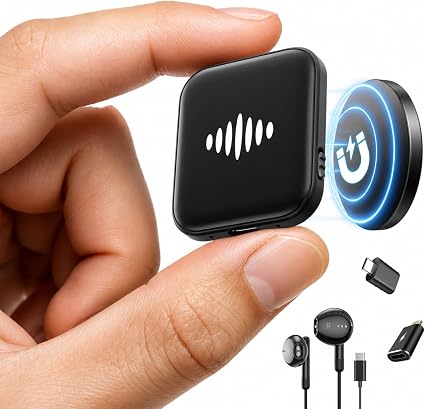
The important split is between a note you capture and an archive you manage. The 132GB Double-Sided Magnetic Voice Activated Recorder suits the second job: it combines voice activation with playback, file transfer, and enough stated capacity to make regular spoken logs easier to store and move. Choose it when managing the files matters almost as much as recording them.
The storage claim is tied to its recording rate. The recorder has 132GB of built-in storage and lists up to 9,800 hours at 32 kbps. It gives separate recording windows by mode: up to 70 hours of continuous recording and up to 100 hours of continuous voice-activated recording. Keeping those figures attached to their modes prevents a large number from answering the wrong question.
Its advantage comes after capture. It has playback and MP3-player functions, a USB-C connection, OTG support for PC and phone devices, and included USB-C and OTG accessories. It also functions as a USB flash drive. If you collect spoken notes, moving them to a computer or compatible phone is part of the purchase decision.
The power routine has two useful details. It charges in two hours, and low-battery auto-save saves a recording when power runs low or the device shuts down. That gives the archive workflow a recovery step, but you still have to keep the files organized. More storage helps only if you will actually keep, move, or revisit more recordings.
This is the right choice for longer or more frequent spoken logs, especially when playback and USB-C or OTG transfer belong in the same loop. For a single short note and the smallest set of physical decisions, the 64GB Small-Pocket Voice Activated Recorder is the cleaner fit. For a self-contained record, play, and MP3/WAV transfer routine, the Aomago is the better alternative.
Aomago 64GB Mini Voice Activated Recorder: self-contained playback and transfer
A recorder that also plays files answers a different question from one designed mainly to capture them. The Aomago 64GB Mini Voice Activated Recorder suits readers who want one small device to capture the fragment, save it, play it back, and move it to a computer later. Its advantage is keeping recording and listening in the same loop.
Its voice-activated mode is built for catching spoken words without filling the file with the silent portions around them. When you want more direct control, the recorder uses a three-click sequence for recording, saving, and playing. That makes the self-contained workflow easy to picture: start the note, save it, and listen back without turning to a separate phone or app.
A-B repeat lets you return to a selected passage instead of starting from the beginning. MP3 and WAV support gives you two file formats for later handling. The supplied USB cable transfers files to a computer, and the recorder is Mac-compatible, so you can move the spoken note off the recorder when you are ready to sort it.
The mini, portable form supports a reachable bedside placement without asking for much space. Its compromise is about priority: the 64GB Small-Pocket Voice Activated Recorder supplies the clearest charging and continuous-recording figures in this lineup, while the 132GB model brings more archive headroom and USB-C/OTG movement. Choose the Aomago when onboard playback, A-B repeat, MP3/WAV files, and a supplied-USB transfer path matter more than those other models' storage or power emphasis. It keeps the bedside job pleasantly literal: record the thought, save it, and let the more awake version of you sort it out later.
Choice and first-night check
Match the recorder to the friction you are actually trying to remove. Choose the 64GB Small-Pocket model for one-switch capture and explicit power planning, the 132GB model for longer logs and file movement, or the Aomago for self-contained playback and familiar formats.
Before using it, place the recorder where your hand can reach it without a search, select the voice-activated or physical-control routine you intend to use, and make one short spoken note. Then save or transfer that file once while you are fully awake. A small routine is easier to repeat than an elaborate one, and it leaves the recorder doing the simple job you bought it for.