Can You Read in a Lucid Dream? What Happens to Text?
Many dreamers can read in a lucid dream, briefly and with quirks. Why dream text changes between glances, the split between letters and meaning, and one small check worth knowing.
On this page
Many dreamers do read in dreams, including lucid ones. It usually does not work like waking reading: short, familiar text tends to survive, while paragraphs are the part that misbehaves. The rest of this article explains why text changes between glances, why pages that made sense in the dream can still be impossible to reproduce later, which differences between dreamers are real, and one small check worth knowing if you want a concrete thing to do in a lucid dream.
The short answer
Many dreamers can read in a lucid dream. It works in layers: short, familiar text is the most reliable, while longer passages are where things fall apart. A common explanation is that dream text is composed as you go, so a second glance produces a fresh version and details like letter order drift. Comprehension usually survives even when the string does not. That same instability is why a read, look away, look back check is a widely taught lucidity test. Your experience, stable or scrambled, is not a universal rule.
So, can you read in a lucid dream?
The honest answer is that reading in a lucid dream behaves in tiers, so what you can read depends on what kind of text you meet. Short and familiar strings read most reliably: a word on a door, the name at the top of a letter, a street sign. Brief sentences come next, and some dreamers manage a couple of lines that stay put. The rare case is calm letter-by-letter reading of an entire paragraph from start to finish, the way you are reading this one. Most people do not get it, and the widely reported pattern for the fuller text is that it behaves on its first reading and misbehaves the moment it is looked at again. That is common dreamer experience as reported, not a measured rule.
One exception shows up across many reports while applying to nobody automatically: highly familiar strings read as units. Your own name, the word STOP on the red sign, an exit marker. The offered reading is that these items are recalled whole, like a picture, rather than assembled letter by letter, and assembly is exactly what dream text does badly.
Lucidity itself does not repair text. Plenty of dreamers report the same shifting letters and repainted signs inside lucid dreams as anywhere else. That means a lucid dreamer who cannot make out a label is not witnessing a defect in their lucidity. The reading trouble travels with the dreaming.
Why does dream text change when you look away and back?
The maddening part is rarely the first look. You glance at a page, it reads, the scene moves on, everything works. Then you look away and look back, and the sentence you just read is different, or has become something that will not parse at all. Regular dreamers know this moment well, and it usually arrives with an unfair feeling, since nothing in you changed between the two looks.
The account most often offered goes like this: a dream is composed as you experience it, moment by moment, out of whatever the scene needs right now. There is no finished document stored somewhere that a dream eye could consult. So a second look is not checking the same text again. It is a fresh generation of the same scene, and the fresh version differs wherever the details were never doing much work, which for text is nearly everywhere: letter order, exact wording, the numbers on a clock.
The instability takes recognizable shapes, and they vary by dreamer rather than following one script. Letters that were legible a moment ago float, shrink, or rearrange into shapes that nearly look like writing but refuse to be letters. Words keep their shape and change their meaning between looks. A sign insists it says something you already know it does not say, which is as disorienting as it sounds, because you are remembering the true sentence and the drawn letters argue with it. Clocks and numbers are the classic, digits that rewrite themselves between glances. Some dreamers meet all of these. Some meet none. Each one is a report of what certain dreamers have noticed, not a catalog of what always happens.

The second look being such a reliable failure point is a strength of this account rather than a stray symptom. If the dream were displaying a fixed page, re-reading would be the most trustworthy part of looking at text, since you would see the same thing twice. Re-reading instead is the fastest way to lose the text, which is exactly what a dream that composes on request should do, and what a fixed page could not. The usual brain-level framing is that the dreaming brain handles stable, sequential detail like letter tracking poorly, with reduced activity in the prefrontal areas offered as part of the explanation. That is the commonly offered account, not a settled fact, and it points to the same short attention budget that keeps conscious moments in dreams so brief.
If the letters fall apart, why did the page make sense?
Because the dream carries two layers, and only one is fragile. Call them the meaning and the string. The meaning is the composed sense of the scene, what the document was for, who wrote it, why the plot needed it. The string is the exact sequence of letters on the page. Dream comprehension runs on the meaning layer, which holds up well, so a word you cannot reproduce the next morning can still have read perfectly inside the dream. As a hypothetical, imagine a dreamer opening a letter that fits the story precisely, unexpected news from a relative no dream has mentioned before, and feeling it land the way a plot turn should. The next morning they can summarize the gist without effort and cannot reproduce a single sentence of the letter itself. Both memories are accurate. The meaning was real and intact, and the string never received a stable version to preserve.
Dream speech runs the comparison for you. Most dreamers hold long conversations that flow without anyone hunting for a word, in the same mind where a written menu refuses to hold its shape. Comprehension of spoken meaning behaves as it does awake, while anything with visible letter positions behaves as if it is being redrawn every time it is looked at. The fragility is letter-level and visual, not language-level, and text softness is one flavor of a wider dream-perception softness, kin to why some dreams look blurry and unclear while everything inside them still works.
Do not carry the finding backward, though. Retesting a remembered dream text against its remembered meaning invites nonsense, since the two were never the same object in the dream. A missing exact wording does not falsify a memory of meaning, and a scrambled remembered string does not undo what the scene made of it.
Other dreamers read fine and you can't: who is right?
Two dreamers compare notes. One reads the menu, finishes paragraphs, sometimes writes. One cannot hold a headline for three seconds. Both can be reporting their nights accurately, because reading in dreams depends on several things at once, and those things differ between people.
Familiarity with the content does some of the work: strings practiced daily in waking life read more reliably than a stranger's label, which fits the unit-recall picture above. Practice with language seems to matter too. People whose waking life leans hard on words, writers and editors and heavy readers, report reading and even writing in dreams more often, and you will hear this in plenty of dreamer accounts and practitioner pages, which is the level of support that claim actually has. Attention habits and plain individual differences supply the rest. The honest form of every line above is 'some dreamers, some of the time.'
The famous version of it, 'you cannot read in dreams', did not come from nowhere, and seeing how it travels keeps it from hardening back into a law. Compressed descriptions of genuinely common instability go around in popular pages and short videos, and along the way they get rewritten: an often-true pattern tightens into an absolute rule, confident-looking percentages appear, and brain claims get attached that the sources they rode in on never pinned down. Numbers feel like authority even with nothing verifiable behind them, and fake precision is exactly how a rough, useful map becomes a superstition.
The discipline runs in both directions. A blanket claim of that shape is a summary of what dreamers most often report, not a law of dreaming, and direct observation can override it for your own case. It cuts the same way against your success. If your last dream read perfectly, that is a true report about last night, not a rule for anyone else, and not evidence that anybody was doing it wrong instead. If your last dream scrambled every sign it showed you, the same modesty applies. The one claim you can safely keep is that your next dream might do either.
Should you be checking text during a lucid dream?
Instability on a second look is annoying inside the dream and useful after it, since it is exactly the behavior the widely taught reading reality check turns into a signal. Run the check awake first, so the habit can carry over, and only the habit carries: nothing about your sleep is being bet on a technique you have never rehearsed.
The sequence is short.
- Pick any text near you, a sentence on a package, a page, a phone.
- Read it once, briefly, the way you naturally read.
- Hold what it said in mind and look away.
- Look back and read again, checking it against what you held.
Awake, it will not change, and that is the point of the rehearsal. Reading text twice on purpose, the second pass genuinely expecting a difference, is what keeps the check active instead of sliding into an idle glance ritual that never gets compared. In a dream, assuming you remember to try it, the same sequence applies, with no equipment, no posture and no special light.
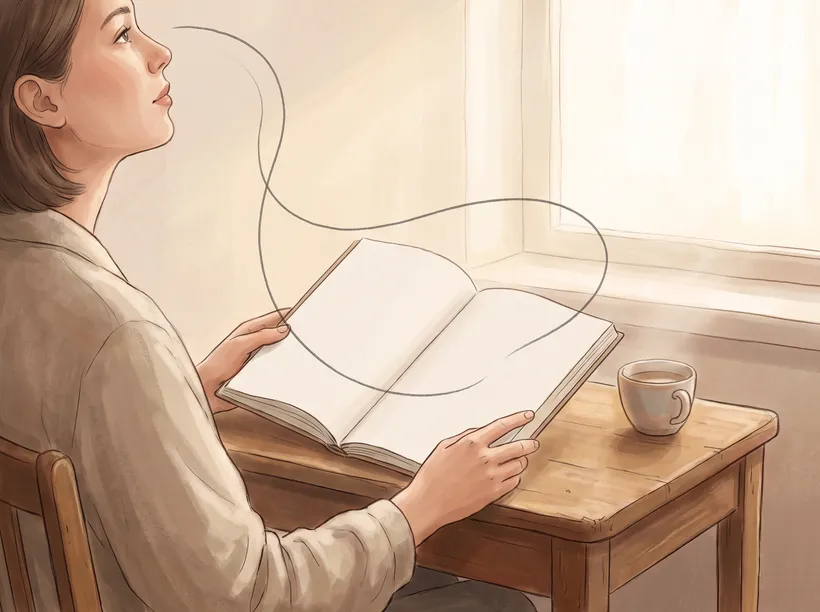
What the results mean is honestly one-sided. Text that changes between looks is a strong practical cue for the dreamers who find one, and noticing it plants the thought 'this is a dream' inside the scene, which is a promising position to be in. A completely stable, ordinary reading shows nothing either way, because dream text sometimes reads normal, for plenty of dreamers, lucid and not. Treat each check as one sample you happened to take.
Keep the notes small enough to write half awake: what the text was, what it did on the second look, and whether the meaning held when the letters did not. That is a complete record. If you want the canonical short description of the check, it lives on the Wikibooks lucid dreaming pages, and the reading version is one example in the wider family of reality checks worth having in the toolbox.
Keep the procedure itself inside a few seconds of glance work. No device, no alarm and no scheduled midnight waking belongs in this routine, because trading sleep for it buys nothing this practice can pay back.
Tonight, whatever text is nearest, glance at it, look away, and look back. It will be exactly the same. That dull, reliable result is the contrast the dreaming version of the check was built to catch.